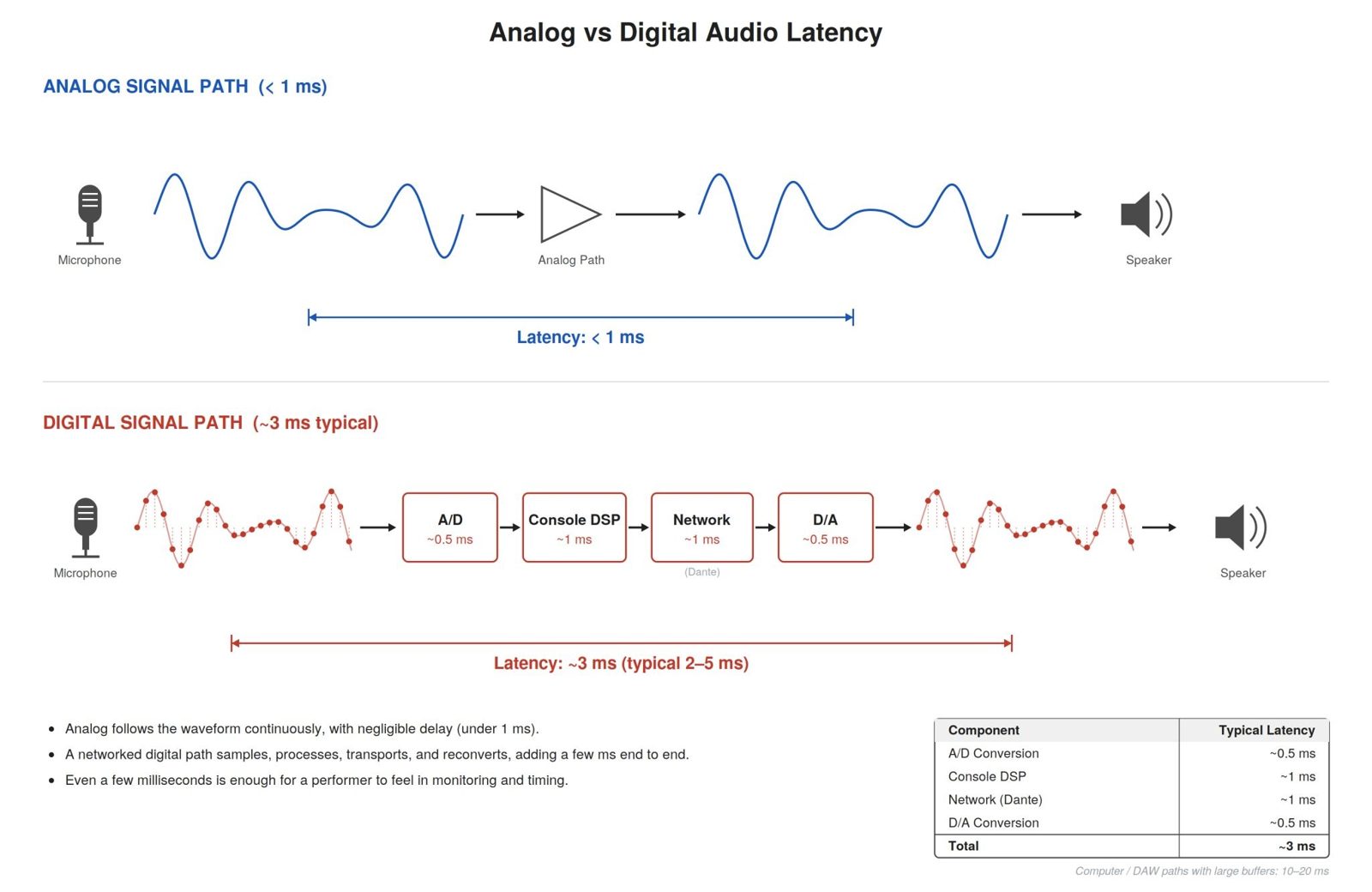
The fastest signal path in your building is still analog. Digital won, and for most of what we build it deserved to. Recall, routing, processing, clean transport over distance. None of that is in question. What is in question is the reflex that reaches for digital every time without asking what the signal actually needs.
Latency is where this shows most plainly. Analog has effectively none, because the signal moves at the speed of the circuit, while every conversion, every transport hop, and every DSP stage adds delay that accumulates down the chain. In a time-critical path that accumulation is the whole problem.
I have stood on stages where a few milliseconds in my own monitor was enough to pull me off the moment, because the ear and the body disagree about when a note happened, and a performer feels that long before any meter shows it. An analog path sidesteps the entire conversion round trip. That is not nostalgia, it is physics doing you a favor.
The same logic reaches into video, where an analog confidence feed gets an image to a camera operator with delay you do not have to budget for. Most of that world has gone digital and solved latency its own way, but the principle holds: when timing is the requirement, the shortest path wins.
The engineer who clings to analog is making a mistake. So is the one who reaches past it without thinking. Dante, Milan, NDI, SDVoE, and ST 2110 are superb transports, and when you need routing, recall, and flexibility across a building, that is where you go. When the requirement is simply the shortest distance between a source and an ear, analog still wins.
The job was never to pick an era. It was to pick what the room and the moment require.
Where does your team reach for digital out of habit instead of need?