Tell me a subwoofer is cardioid, and my first question is always the same. Cardioid at what frequency?
Cardioid subwoofers get sold as a default upgrade, the box that finally fixes your low end. They are a real tool that solves a real problem, but only one problem, and only over part of the spectrum.
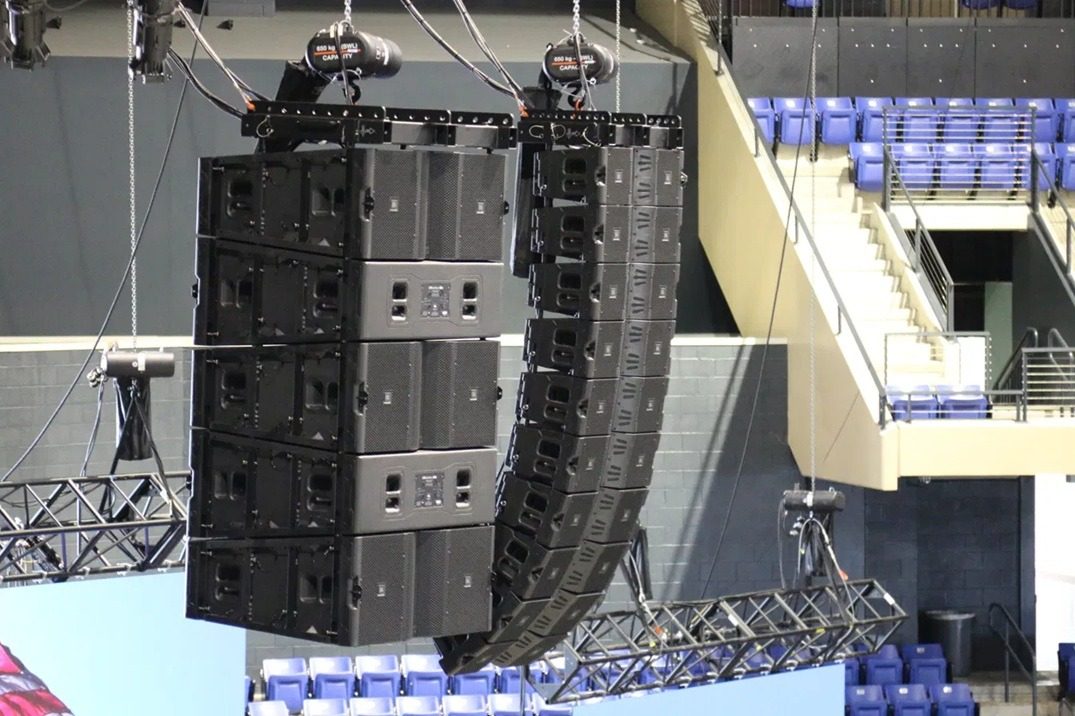
My first major deployment was a JBL Professional VTX line array at the Berry Center in Cypress, Texas. We ran the subs in a 3 to 2 gradient, 3 cabinets forward and 2 reversed, to cancel low frequency energy off the back of the array and keep it out of the seats behind the stage. It accomplished what we wanted, but at the same time, It also taught me what the technique does and does not do.
Below roughly 200 Hz a subwoofer radiates omnidirectionally, because the cabinet is small compared to the wavelength it is producing. Directional low frequency is interference sources arranged so their outputs cancel in one direction and sum in another. The control that is achieved is governed by wavelength. The spacing of the elements sets the band where the cancellation happens, and the rejection is centered on a target range. Above and below that range, the control falls off. A cardioid sub is not a cabinet that points your bass forward at every frequency. It is a configuration that cancels energy behind it across a limited band.
The concept has improved. Manual gradient arrays gave way to processed presets, and now to single-enclosure cardioid subwoofers like the L-Acoustics, which packs four 21 inch drivers into one box, two firing forward and two side mounted, with selectable cardioid, supercardioid, and side rejection modes. Until recently a cardioid deployment handled the rear and little else, so the side rejection in cabinets like the CS1 is a real step forward, but there are still trade-offs.
Here is what the brochure skips. Cardioid is subtractive. It controls a single axis, front to rear, by cancelling energy. The traditional technique does nothing for the sides or the vertical, so a standard deployment can push that redistributed energy beside and beneath the array, into the stage and the structure, which is often where it is least wanted. You also pay for the control: more amplifier channels, more boxes, more weight, more cost, and a harder deployment, because part of the system is working against itself by design.
Cardioid subs are the right answer to a rear energy problem. They are the wrong answer to “make my low end better.” Decide what you are fixing, and at what frequency, before you spend the weight and the budget. Then measure it in the room, because the polar response you designed and the one the building gives you are never the same. Buy for the application, not the spec sheet.
Complex systems. Seamless experiences.