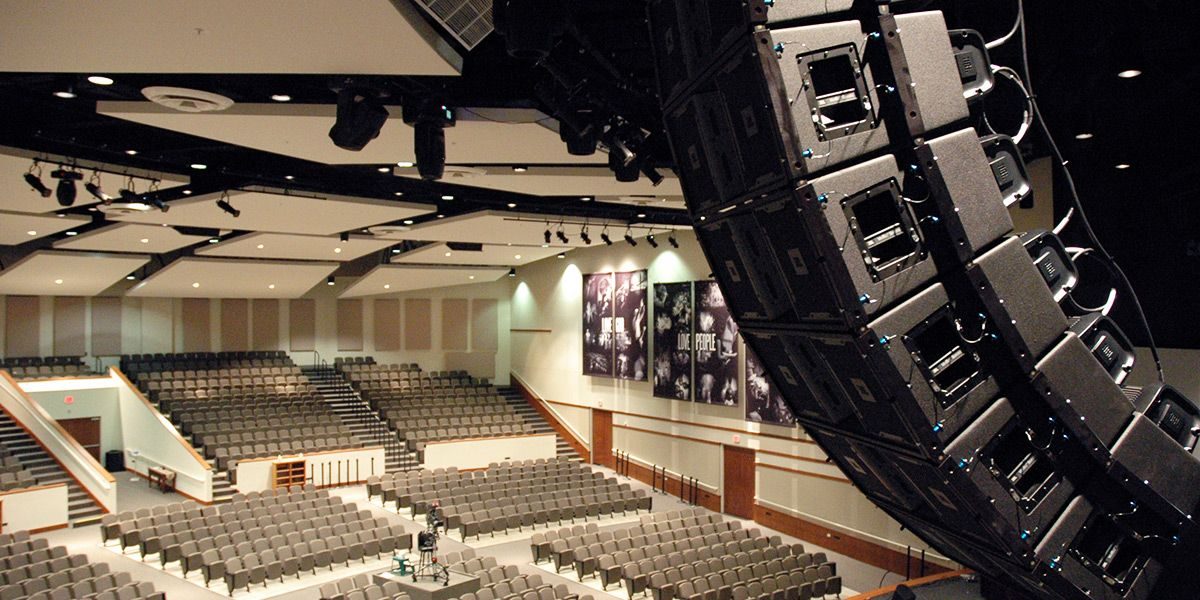
Line arrays look impressive. They photograph well. They signal “serious system.” And in the right room, they are exactly the right tool.
They are also routinely specified in rooms where the physics works against the design. The clearest example is the wide, fan-shaped house of worship. A line array’s horizontal pattern is fixed by the cabinet, typically 90 to 120 degrees, and it does not widen with array length. Seating that spreads 140 degrees or more across a shallow room cannot be covered by adding boxes. You can extend vertical throw all day. You cannot stack your way to horizontal coverage.
The phasing problem compounds it. Line array elements rely on coherent summation in the vertical plane, which depends on element spacing, splay angles, and wavelength. As splay angles open past roughly 5 to 7 degrees in the lower mids, coherence collapses. The array stops behaving like a line source where intelligibility lives, typically 250 Hz to 2 kHz. Comb filtering appears in the overlap zones. Lobing shows up off-axis. The system measures clean on-axis and disappoints everywhere else.
In wide, shallow rooms, a properly designed point-source or distributed system almost always outperforms a line array. Horn patterns can be matched to the actual seating geometry. Coverage zones can be tuned and time-aligned individually. SPL targets can be hit without sacrificing pattern control.
I was recently at Walt Disney World and was impressed by their deployment of the right type of PA for their spaces. Most attractions and shows use point-source boxes in configurations matched to the specific space and sightlines.
Line arrays appear where the geometry rewards a line source: deep throw, narrow horizontal spread, controlled acoustics. The choice is driven by the room, not the visual.
Coverage is a math problem, not a marketing problem.
Complex systems. Seamless experiences.