If someone tells me a sound system is running at 96 dB, I still need to know the reference. If someone tells me a microphone preamp has 60 dB of gain, I do not. Gain already describes the relationship between its input and output.
A decibel expresses a ratio. Sometimes that ratio is relative to a defined reference, and sometimes the ratio itself is the measurement. For absolute levels, the reference matters. dB SPL uses 20 micropascals. dBu uses 0.775 Vrms and dBV uses 1 Vrms. dBFS is referenced to full scale, the maximum digital level.
The math changes depending on what we are comparing. Power ratios use 10 log. Voltage ratios use 20 log, and so do sound pressure ratios. Double the voltage and the change is 6 dB. Double the power and it is 3 dB.
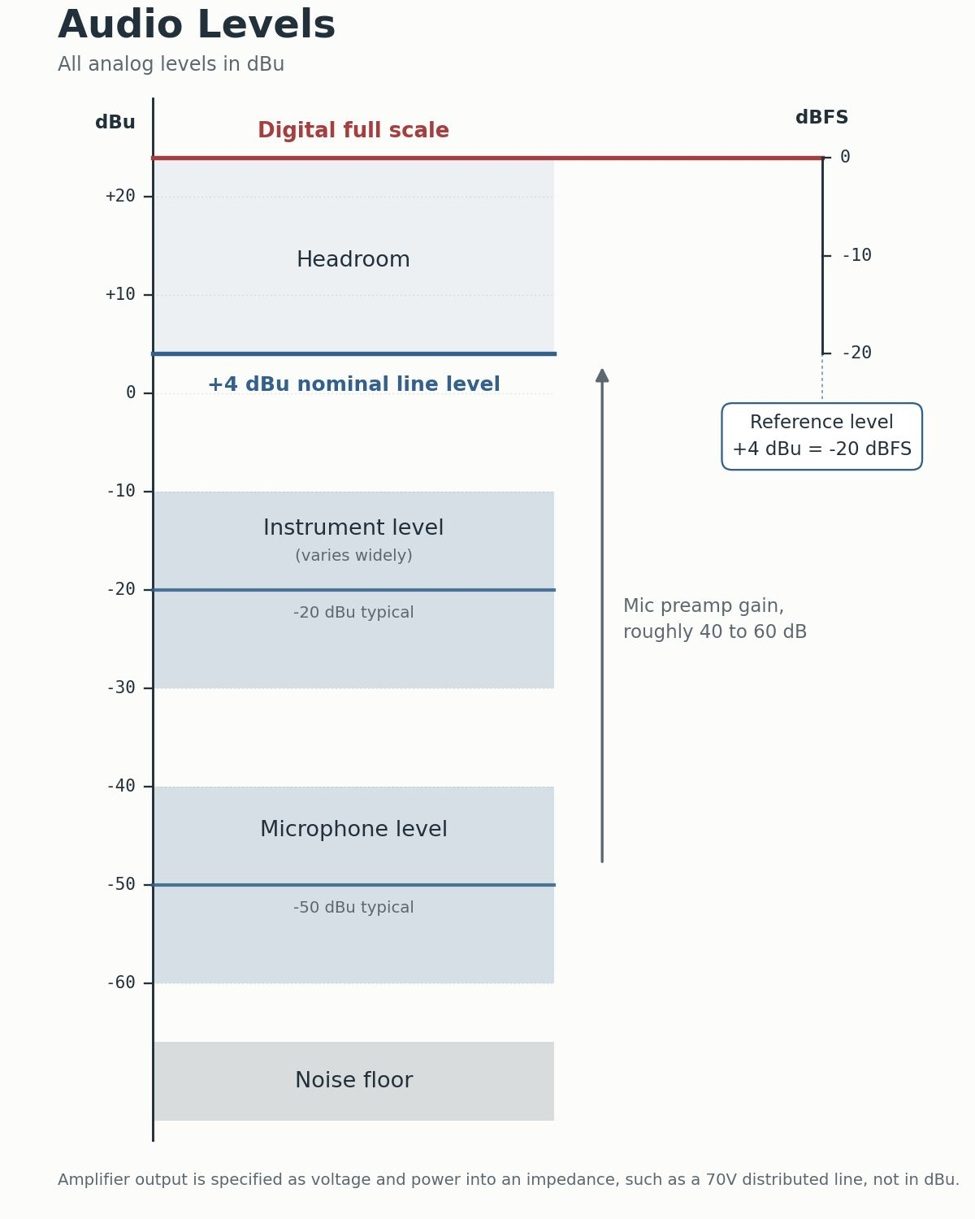
In 2021, I built a training for our team called Audio Levels because I kept walking onto sites during commissioning and finding systems that were noisy, distorted, or both. The engineers were not being careless. Gain structure is genuinely confusing, particularly when analog, digital, microphone, line, and amplifier levels all meet in the same system.
A microphone signal can easily be 40 to 60 dB below nominal line level. Instrument level generally falls somewhere between microphone and line level. Line level is where most of the rack operates. At the amplifier output, we are usually talking about voltage and power delivered into a specific impedance.
Gain structure is the process of keeping each stage inside its intended operating range. There needs to be enough headroom for peaks without clipping, while maintaining enough signal above the noise floor that we are not amplifying hiss farther down the chain.
The analog-to-digital handoff deserves particular attention. If +4 dBu equals -20 dBFS in one part of the system and -18 dBFS somewhere else, everything still works, but you have introduced a 2 dB disagreement between those stages. Pick a reference level and document it. Mine is -20 dBFS.
Exceed the intended operating range of an analog stage and distortion increases. At digital full scale there is nowhere else for the waveform to go.
You cannot fix bad gain structure with the fader. By the time the signal reaches it, everything upstream has already happened.
Complex systems. Seamless experiences.