Arturo Sandoval's rider specified a ribbon mic. That was 15 years ago and I was mixing front of house. It wasn't my first experience with ribbons, but my experience had been studio work and this felt like a risky choice. A trumpet at close range is one of the loudest sources you will ever mic, and I assumed a ribbon would either fail to handle it or tear.
A ribbon microphone is a simple concept and one of the oldest designs. The big RCA microphones sitting in front of announcers in every 1930s radio photograph, the 44 and the 77, are ribbons, and the principle has not changed since. A strip of corrugated aluminum foil, just a few microns thick, is suspended in a magnetic field. Air moves the ribbon which induces a small voltage in the foil. That tiny foil is the entire transducer. It responds to the velocity of the air moving across it rather than pressure loading one side of a diaphragm like a condenser or dynamic mic.
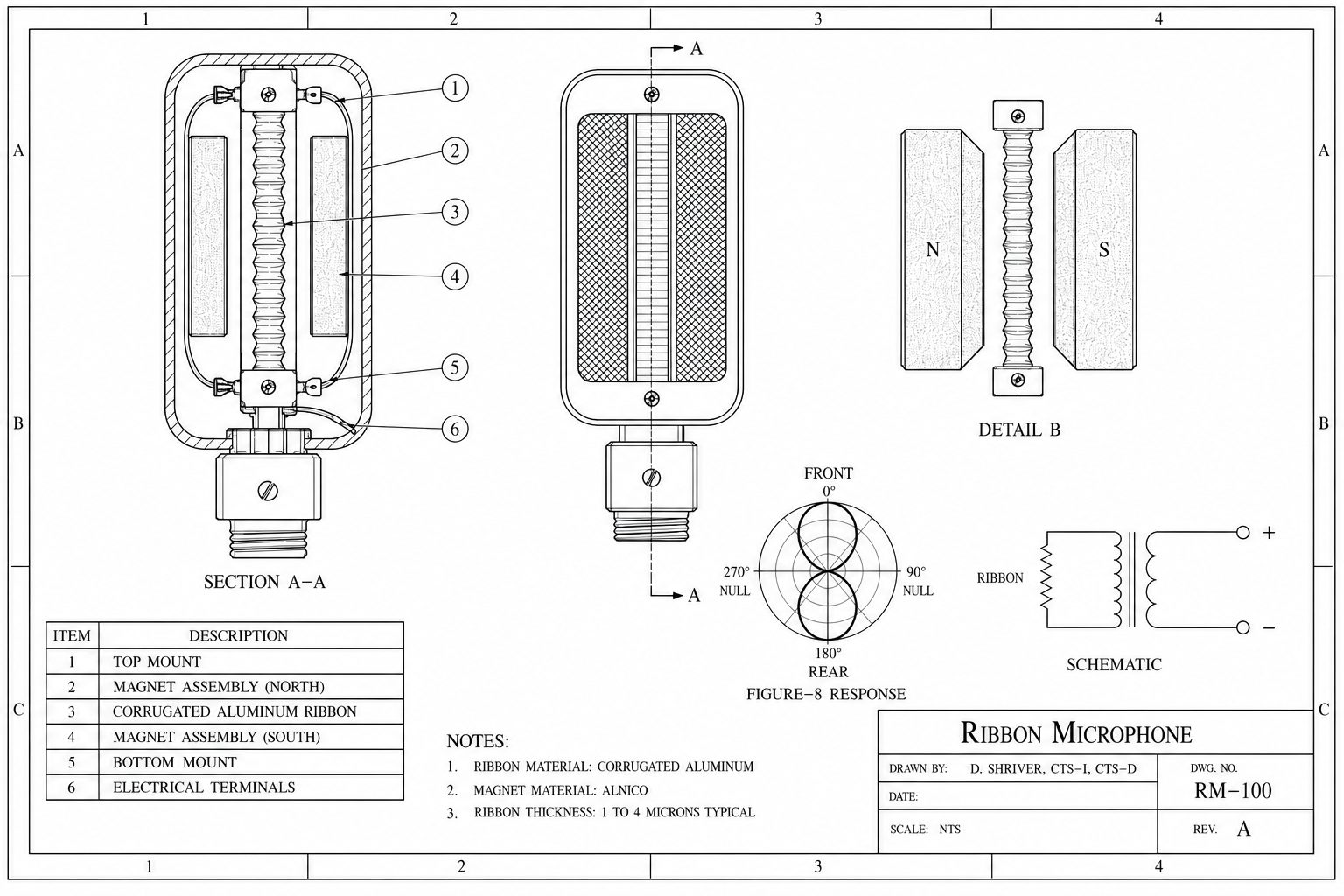
I had the failure mode wrong though. Ribbons die from sustained air movement, not raw sound pressure, which is why wind, plosives, and the inside of a kick drum are the real hazards. A loud horn is not a wind source, and ribbons have been the studio standard on brass for decades for exactly that reason.
Sandoval played 2 sets. Smooth through the top, with no edge anywhere in the loud passages. That Royer Labs mic held up through all of it.
Earlier this year I was in the audience at a Lukas Nelson concert and saw a ribbon again. This time as a vocal mic for Lukas. It surprised me all over again and made me think back to that concert with Arturo. Same rich and even character with no harshness in it. That's the beauty of a ribbon.
Ribbons are not new to the stage. The beyerdynamic North America M160 has been working live since the 1950s, and it survived out there partly because it was a hypercardioid rather than the typical figure-8. What has changed is everything around the ribbon itself. Active designs put a buffer preamp inside the microphone, so instead of being endangered by phantom power they require it. Passive ribbons still get patched with the phantom power off, though modern ones are far more forgiving than their reputation. Internal shock mounting has improved to where road use is routine rather than brave. The M160 is no longer the outlier, since acoustic labyrinth designs now produce cardioid, hypercardioid, and supercardioid ribbons.
The pattern is the thing that really makes ribbons viable on a live stage. A figure-8 hears the rear as well as the front, so the wedges and whatever else is behind the mic land in it. A directional ribbon removes the objection that kept most ribbons off stages for 50 years.
The rider was right and I was wrong. Pick the transducer for the source and the room, not for the category it usually lives in.