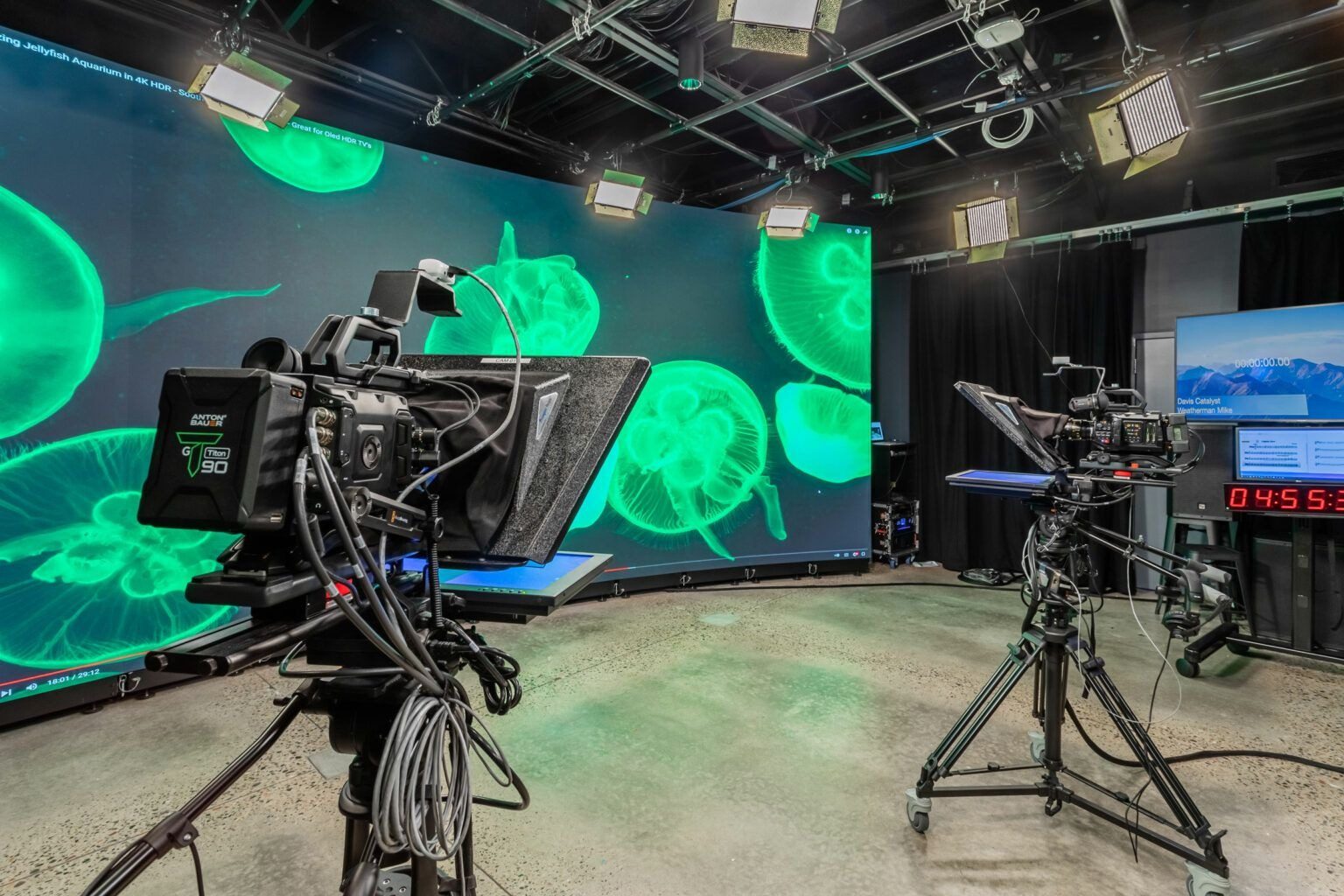
You have seen virtual production, even if you did not know what it was called. It is the technology behind The Mandalorian, where the actors performed inside a massive curved wall of LED panels instead of in front of a green screen. The background was not dropped in afterward. It was playing on the wall in real time, and the camera captured it live, in the shot.
Our team recently engineered and installed a virtual production studio built on this same approach. The technology photographs beautifully and demos even better, but what rarely gets discussed is everything that has to work together behind the wall to make any of it convincing.
The first thing to understand is that the LED wall is not just a backdrop. It is a light source. When a performer stands inside the volume, the scene on the wall lights their face, casts the right color across the set, and reflects correctly in their eyes and on the surfaces around them. A green screen can never do that. With green screen you light the subject separately and hope it matches an environment you add later. In a volume, the environment and the lighting are the same thing, and that is what sells the shot to the camera.
That is also what makes it hard. A wall built to be looked at by a camera at close range is far more demanding than one built to be seen by an audience across a room. It has to hold accurate color, refresh fast enough to stay clean under a camera shutter, and use a fine enough pixel pitch that the lens does not pick up the grid. These are about the hardest conditions you can put an LED wall under.
Then the wall has to move with the camera. The system tracks exactly where the camera is and where it is pointed, and the rendering engine shifts the perspective of the background to match in real time. Move the camera, and the virtual world has to move with it correctly, or the depth falls apart. The wall, the cameras, the tracking, and the render engine all have to stay locked together. The moment any of them drifts, the camera catches it, even when your eye would not.
None of this is purely a film problem or purely an AV problem. It is both at the same time. Virtual production lives exactly where broadcast, film, networking, real-time rendering, and large-scale display integration all meet, and getting those worlds to speak the same language is the real work.
The gear gets the attention. The integration is what makes it believable.
Complex systems. Seamless experiences.