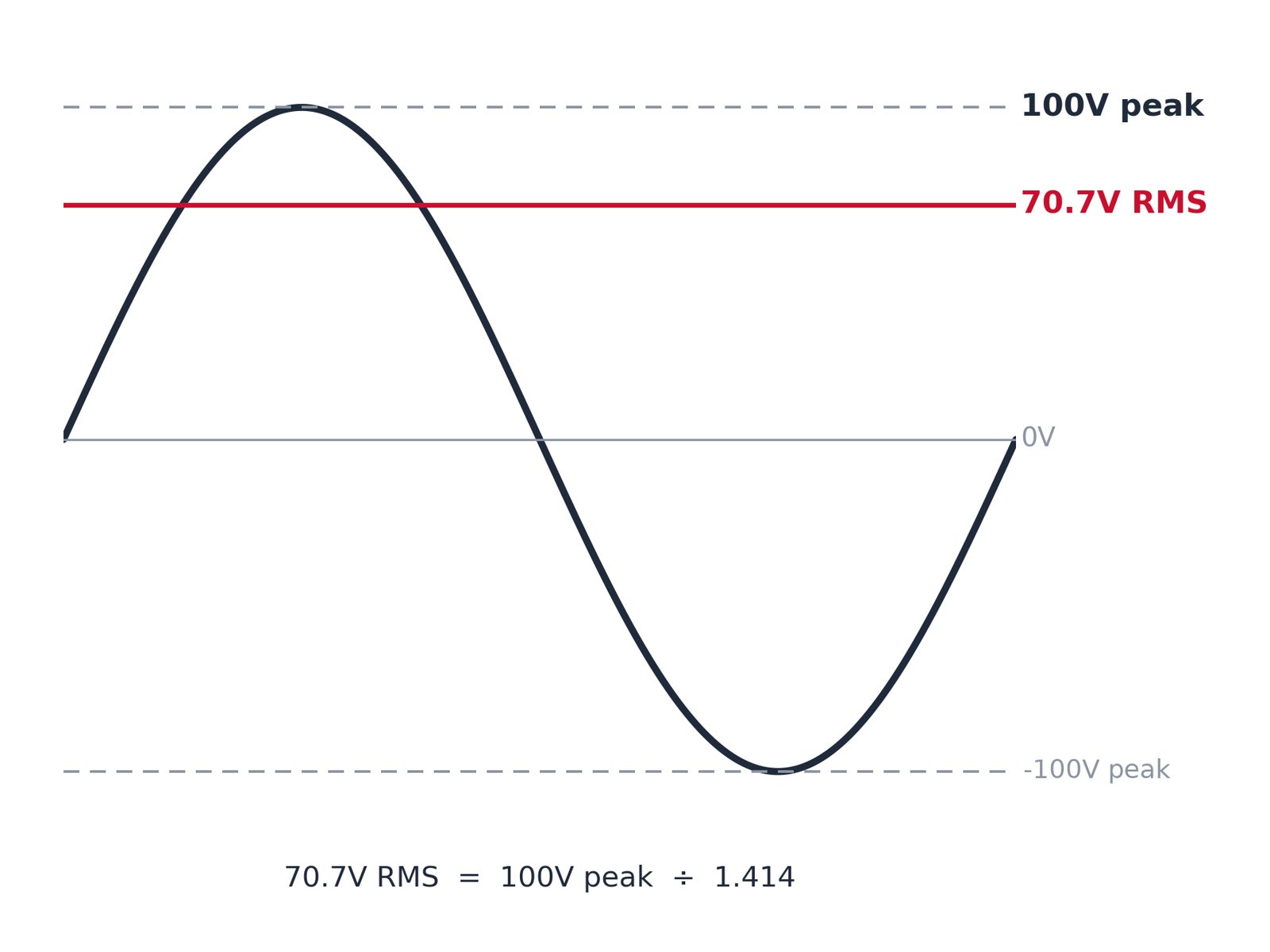
Why is a 70V speaker system actually 70.7 volts? It is an oddly specific number, and the reason has almost nothing to do with loudspeakers.
The North American standard traces back to a 100V peak threshold in the electrical code. A speaker line is AC, swinging from a positive peak through zero to a negative peak. Amplifier ratings describe that swing by its RMS value, the DC voltage that would deliver the same power into the same load. For a sine wave, the peak is the square root of 2, about 1.414, times the RMS value. Designers started from the 100V ceiling, divided by 1.414, and 70.7V RMS became the line voltage at the amplifier's rated output.
Most of the rest of the world standardized on 100V RMS instead, about 141V peak. That is why so many commercial amplifiers offer both settings, something that used to puzzle me.
The real appeal of constant-voltage distribution is the wiring. A low-impedance 8Ω system moves high current, so every long run means heavier cable and a line-loss calculation. At 70.7V the current is a fraction of that, and small-gauge conductor can loop from speaker to speaker across a large space, every speaker in parallel on the same pair. The design gets simpler too. A 70V tap is a power allocation, so 20 ceiling speakers tapped at 15 watts commit 300 watts of amplifier capacity. Add the taps, compare the total with the amplifier rating, and leave margin.
There is a persistent assumption that 8Ω sounds better than 70V. With cheap transformers, it often does. With good transformers and proper high-pass filtering, a 70V system on long runs can match an 8Ω design, and it can beat one once the cable losses on the 8Ω side are counted.
A project here in Houston about 10 years ago started with a consultant's spec for 8Ω ceiling speakers and subs. The owner wanted an open cafe that could double as a performance space, and the assumption was that 70V could not deliver that kind of fidelity. The IDF was on a different floor, so the runs were about 800 feet. We proposed a constant-voltage design with 16 high-quality 70V ceiling speakers and 4 subs on good transformers. It was easier to install, used far less wire, saved a few thousand dollars, and sounded fantastic.
Before specifying 8Ω for fidelity, count the speakers, measure the runs, and listen to a well-built 70V system.