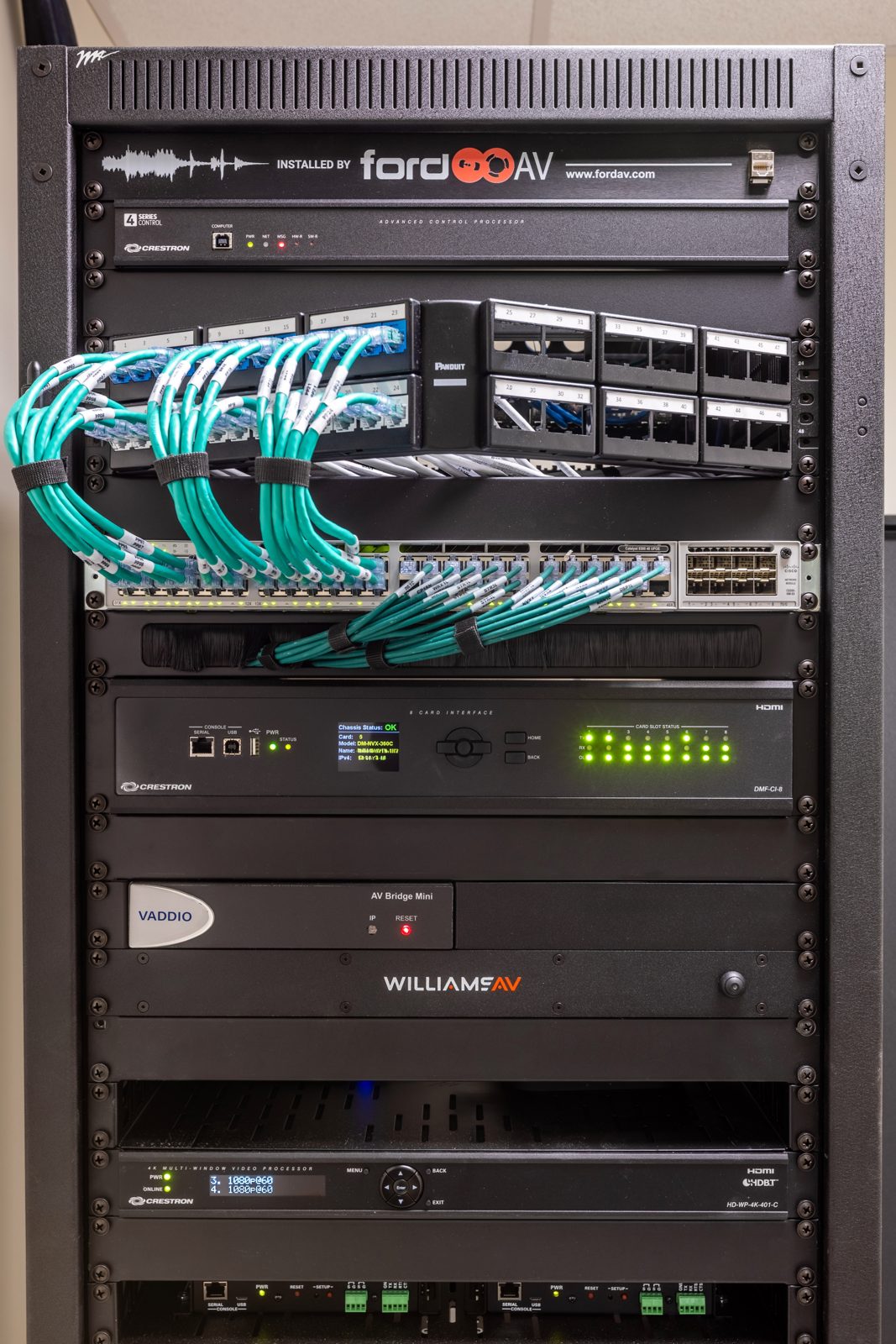
 Ford AV rack: Crestron DM NVX AV-over-IP feeding a Cisco Catalyst switch." loading="lazy">
The most common network mandate I see on large AV projects is also the one I push back on hardest: put every AV device on the enterprise network.
We built the C-suite spaces and divisible training rooms for a Fortune 1000 company with a large Houston presence, under exactly that mandate. We coordinated with their network teams before the first rack was loaded, and the project still went sideways on 3 separate fronts.
First, whitelisting. Every device required an approval that took several hours per request, so commissioning crawled, and any replacement unit sat dark until its own request cleared.
Second, traffic. The AV over IP streams landed on a segment where multicast had never been constrained to the ports that wanted it, and the resulting flood did not stay in our corner. It took the AV down and degraded BACnet and VoIP with it.
Third, security. Once the system was stable, their white hat team tested our equipment the way they would test any new endpoint on the network. The endpoints in this system were not designed to absorb 10,000 connection attempts per second, and devices kept shutting down with no visible cause until our network engineers left Wireshark running overnight and found millions of attempts against our equipment.
Two of those 3 failures were the network doing its job correctly. Tight onboarding and hard security testing are exactly what an enterprise network should do. The third was a network that had never been asked to carry sustained multicast and had not been configured or validated for it and that's the distinction that really matters. A properly engineered enterprise network can carry AV. Synchronized PTP clocking, sustained multicast, and real-time media are all within reach of the right design. No enterprise network is automatically ready for that traffic, and the mandate assumes it is.
A dedicated AV network rarely means a second physical plant. Proper segmentation usually gets there: a media VLAN with IGMP snooping and a querier, QoS built for timing-sensitive and real-time traffic, and a security policy written for the devices living on that segment. We can reserve physical separation for the systems that must keep running when everything else fails or for the cases that enterprise networks cannot handle the AV traffic. Mass notification is the perfect example.
Match the network to the work it has to carry, and validate it against that work before turnover. If you do, then the AV disappears into reliable operation, which was the goal of AV/IT convergence from the start.
Complex systems. Seamless experiences.